1 / 1
Singapore Tatler steps into the shoes of South Korean abstract artist Chun Kwang Young, who shares what defines his art and makes him the man he is

Chun Kwang Young
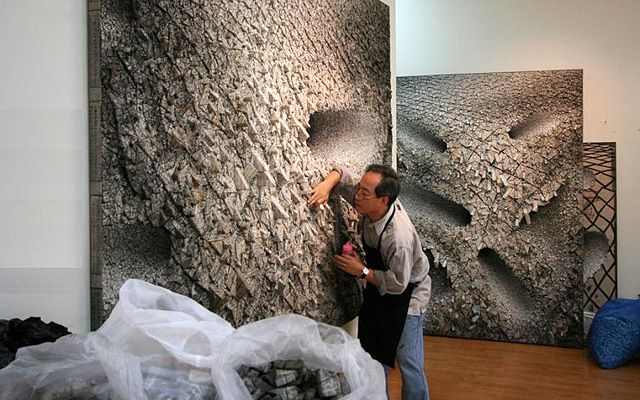
Wandering the coasts of American and European abstract expressionism in the 1970s, South Korean artist Chun Kwang Young had been looking for a way to pay tribute to his Korean heritage when in 1995, he chanced upon Mulberry paper, which is made from bark fibres of the Paper Mulberry tree and commonly used in origami and calligraphy, as well as paper screens and clothing.
Since then, Chun has embraced this technique of creating triangular parcels of Mulberry paper, loading them with singular messages, and applying them onto the surface of the canvas. Oppositions, dualities and obstacles make their way into the canvas, creating various layers of meaning and giving birth to a powerful and aesthetic interpretation of history.
Dubbed artist of the year by The National Museum of Contemporary Art, Seoul in 2001 and awarded the Art Prize by South Korea’s Ministry of Culture, Sports and Tourism in 2009, Chun has shown his works extensively across the globe.
In Singapore recently to introduce his solo exhibition Assemblage at Art Plural Gallery (May 29 – July 27), Chun spoke to Singapore Tatler about his one-of-a-kind artwork in Assemblage, which features the use of Styrofoam wrapped in traditional Mulberry paper.
ST: Why did you choose to work with Mulberry paper?
CKY: When creating Western-influenced art, I felt voiceless. This feeling was akin to copying someone else’s artwork. From then on, I decided to do something that was related to my Korean heritage.
Thus, the reason why I use Mulberry paper in my artwork is because I believe it is something that every Korean can relate to. Mulberry paper can be found everywhere in Korea, from the small medicinal herb parcels to books. I feel that Mulberry paper represents the heart and soul of Korea.

ST: What are you trying to convey to the audience through Assemblage?
CKY: I have noticed that in this age, people just whizz pass everything. They don’t stop and look at things or even if they do, they give superficial comments. For example: that is beautiful, this looks pretty…
What I want is for my audience members to view my artwork with their hearts, to go beyond just viewing it with their eyes, and to be able to understand what I am trying to drive at.
I want to evoke the feeling of the heart connecting, just like how you would yearn for a connection with your lover. I want to be an artist that stirs your heart, to go beyond just the visual excitement.
Apart from this, I want my audience to be able to see Korean history through my art.
ST: What got you interested in abstract art?
CKY: I was from a fairly well-to-do family. Even before I started speaking, my life had been laid out in front of me – when I became of age, I would have taken over the reigns of my father’s company.
In elementary school, when everyone was asked to write down his or her dream occupation, I wrote down that I wanted to be a great artist. Fast forward to junior high, my teacher complimented me on my drawings, and it was then that I decided to be an artist. When I told my dad about my decision, he was furious and told me that if I choose to pursue art as a career, he wouldn’t want to see me anymore. Those words didn’t deter me and I went on to do just that.

ST: What are some of your philosophies in life?
CKY: Regardless of any acknowledgement or recognition that you receive, you must continue to pursue your dreams. I am married to art; I would give up everything just to do art.
1995 was the year where I made the leap to give up Western painting to focus on using Mulberry paper for my pieces. At that time, nobody knew who I was, but I kept on doing what I loved. Now I have my artwork displayed around the world (from Asia to Europe), all because I continued to do what I loved and didn’t give in to unfavourable circumstances.

ST: You’re 69 this year! Any plans to retire soon?
CKY: To me, retiring is equivalent to being dead. I believe that as long as I’m still alive, I will be creating art pieces. However, as dying is inevitable, I would like my artwork to be like (Pablo) Picasso’s – don’t get me mistaken – I’m not chasing after fame. I want people to understand my artwork, so that even after I’m gone from this Earth, memories of me will still be around.
Chun Kwang Young: Assemblage runs at Art Plural Gallery (38 Armenian Street) till July 27, 2013. For more information, visit www.artpluralgallery.com/blog
Photos: Art Plural Gallery
Curated for you
The stories, profiles, and cultural moments featured on our Instagram feed